
Joe Carass
36
Northampton
NuFish
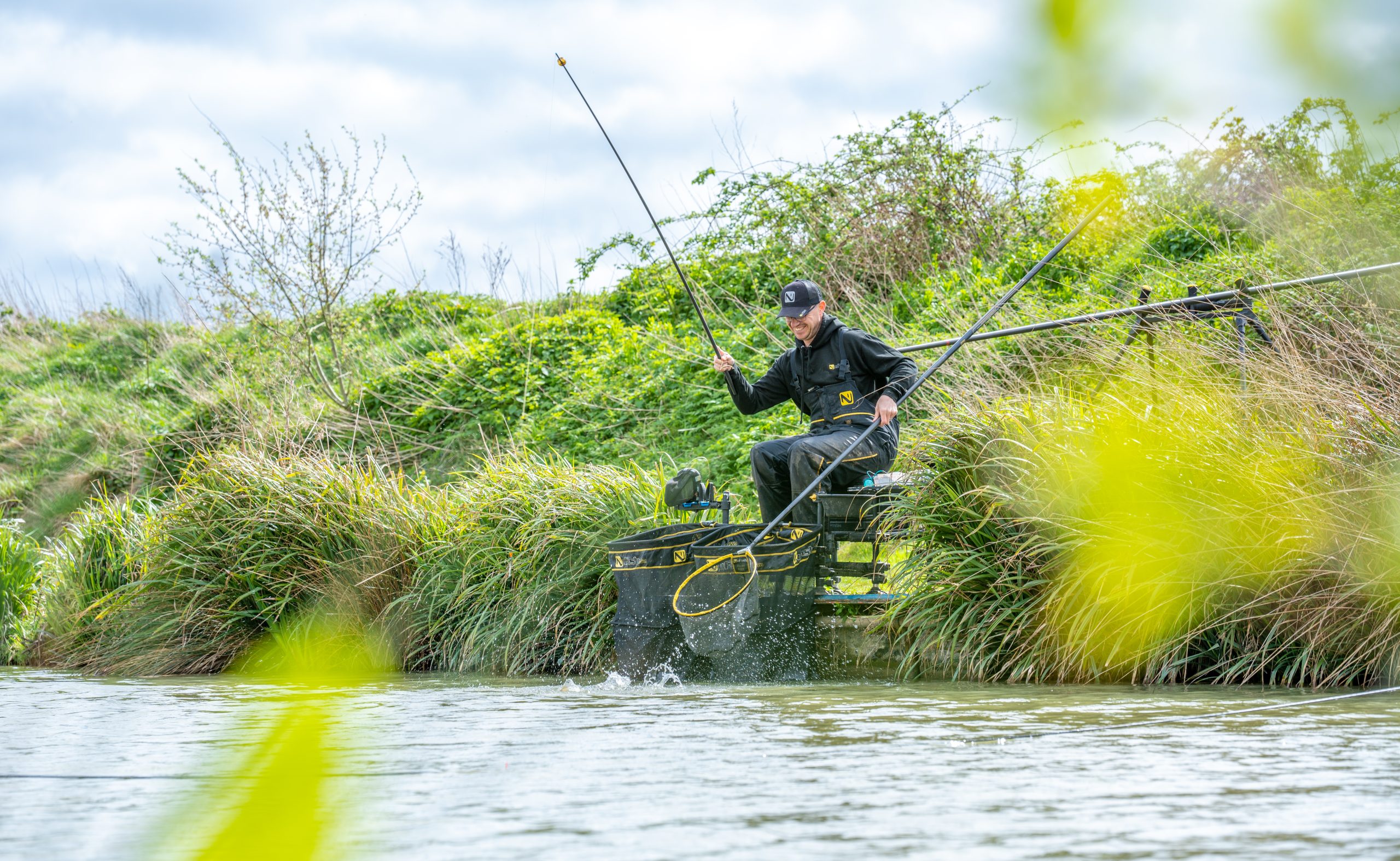
Joe Carass shows that there is always one way to approach a deep island swim when looking for match winning success!
Islands and far bank features are some of the most productive areas of any lake. The fish love the sanctuary and cover they provide and the shallow water is often oxygen rich leading to the fish feeding with confidence when they can be moody in deeper areas.
They are of course great places to target, especially in the first half of the match when the fish naturally back away from the commotion that we cause setting up. So I wanted to talk you through my approach to targeting those far banks and island spots that used to fish themselves but these days seem to be getting harder and harder to get the most from!
Islands – The Issue With Islands!
So we have read countless times anglers explaining the need to find certain depths when targeting islands. A classic example would be summer carp fishing where finding 16in – 20in would result in a lovely days sport. But and this is becoming a really big BUT, there aren’t many fisheries left with shallow island spots!
Our waters are becoming older, more mature and with that the islands have become deeper. Those once shallow island ‘mudlines’ have long been replaced by deeper undercut banks that present a host of problems to the angler.
Take today’s fishery for example, The Banks at Barby. This fishery once had lovely shallow far bank margins in most swims and the fish could be seen tailing up throughout the match. But as with most of these older fisheries, those spots are long gone and now it is rare to find less than three feet tight across. This happens with age as the fish, wildlife and wind erodes the banks over time.
It used to really annoy me that years spent honing the techniques needed to fish these far banks had no gone. But things move on and now I realise these deeper spots are actually excellent places to fish provided you target them in a few different ways.
Approach Number One – The Trap!
Without a doubt the best way to target a shallow island spot is the now common ‘trap setting’ approach. By this I mean feeding a small pot full of micro pellets or groundbait with precision before presenting a stable heavy float over the top until either you get a bite or you feel the ‘trap’ has been disturbed and it needs to be reset. It works amazingly well in shallow water but it needs some thought in those 3ft island swims that we are talking about.
Trap setting can still work well but we need to look at a few things, the first is the bait. Groundbait is a total no go in my opinion, you are just asking for a nightmare with foul hooked fish. Micro pellets are the first option to consider but they need to be prepared in a way that allows them to be fed in ‘clumps’ rather than a loose cascade of pellets. Accuracy is everything and feeding your pile of pellets where you want them is crucial. I prepare my pellets in the usual way that I have come to rely on, fill the Tupperware tub to the brim with 2mm’s, equally fill with water and clip the lid on. A few hours later, perfect pellets.
Once these pellets are prepped I then use a pellet binder. There are several on the market but Horlicks has always been reliable. I am conscious not to use anything with bigger groundbait like particles as that can create problems with liners and I add only just enough Horlicks to stick the pellets, no excess!
These lovely pellets can be fed with varying amount of squeeze wither in balls or pressed firmly into a kinder pot. That part is up to you to work out but my favourite is to feed them as small hard nuggets. You will get fewer indications and the wait for a bite might be slightly longer, but that bite should be a clean bite when it does come.
Hook bait needs to be simple. I like expander pellets in either 4mm or 6mm but will happily use meat or corn over the top especially if the target is carp rather than F1s.
Rigs need to be simple and most importantly fast re-setters. By this I mean a rig that when you strike at liner or miss a bite, you can just lower it back down and it be fishing immediately. There is no place for light floats and a 0.5g DIABLO is the only option for me. This float settles instantly and combined with a solid bulk four inches from the hook I get the required effect.
Feeding needs to be regular but done with care. Be as accurate as you can. Make sure your pole pot is as close to the pole tip as you can get away with. Feed the nugget of pellets first when you ship across and then lower the rig on top. It is important you lower the rig in quickly as the fish will follow that nugget down and you need your hook bait in position straight away so don’t faff around! I will generally ship back and repeat the process every three to four minutes but you should get a feel for the timings when you are fishing. If you get indications quickly and then nothing, always assume the bait has gone. If you don’t get any indications and then a clean bite after a couple of minutes then it is taking the fish a while to find the bait so you can slow things down.
Approach Number Two – Hard Pellets
The more I fish this style of venue the more I go down this route. In fact I was fishing this venue a lot last summer and I focused my entire attack to feeding 4mm and 6mm pellets. I think having less particles in the swim along with creating noise with minimal amounts of bait gives you the ultimate approach which ultimately leads to approach number three which we will cover shortly.
I bring both 4mm and 6mm pellets with me and to be honest I have no preference between the skretting or coppen style pellets. I oil them both with a fish oil which slows the breakdown of skretting pellets anyway. As long as they are uniform in size then I am more than happy.
The reason I bring both sizes with me is purely to gauge how the fish are feeding. On some days just tapping four or five 6mm pellets in and waiting can be excellent. But on others the fish need more activity in the swim to drop their guard and that is where being more aggressive with the 4mm versions can really score.
To start any session I will simply load the pot with a pinch of 6mm pellets, rattle them in from a bit of a height and then gauge the response. If I can catch with this bait then I will stick with it as those larger pellets are the cleanest way to fish by far. When you create so much noise with the pellet size but have very few particles on the bottom the fish can be easy to catch. Sounds easy doesn’t it. Sadly, and this often happens, the 6mms don’t have enough attraction to pull any fish. Even pinging a few over the top won’t necessarily give you the effect that you are looking for.
This is where switching to 4mms comes into its own. I feel with the bigger pellets you are essentially setting trap for one fish at a time. But when you make the switch to 4mms you are continually building the swim and it gets better and better.
Again the pot is always the starting point but playing around with the number of pellets you feed is massive. Some times feeding six to eight will be enough then on other days filling the pot to the brim is everything. I guess this is where experience and experimentation come in to play. But me being me I’m usually loading the pot up!
The next step is working out whether the catty will make or break the session. Trust me I have ruined many a smooth sailing swim by trying to up the ante with the catapult. My advice would be, if you can get regular bites with the pot then stick with it. But if you feel within yourself that the swim could be ramped up another gear, or conversely you aren’t getting the response you need, get the catty out!
Once I get the catty out it is then a case of working out how best to feed to get the best from it. It could be that I feed two pouches of pellets before shipping out or perhaps it is feeding when I hook a fish, or it could even be feeding over the float. You need to work it out. Naturally feeding over the float will increase the likelihood of foul hooking fish and missing bites. But on some days feeding on the float is the only way to get bites.
There was a time when I looked at a simple one tub hard pellet day as a simple straight froward days fishing. But the more I do of it, the more I realise there is so much intricacy and nuance to this simple bait!
I have two rigs for this approach. The first is very similar to the option seen in approach number one. Having a rapid reset rig is invaluable when fishing like this because every time those hard pellets hit the surface you will get indications and it takes a better man than me to not lift into most of them! A 0.4g or 0.5g DIABLO with as bulk is perfect. This allows you to continually lift and then be back set and fishing in the blink of an eye. These heavy rigs give you total control and when you can catch with them it is a huge advantage.
Rig number two flips the script. The fish will naturally be watching the pellets falling through the water and sometimes a lighter more strung rig will work better and to be honest this is always my starting point. I use a 0.3g DIABLO this time but rather than use a bulk I will have a spread of No10 and No9 shot. I don’t like having too many shot on my rig when carp fishing as they become a nuisance when they move. So I prefer having the last two shot as No10s and then the rest of the loading will be made of No9s. If I can have four or five shot on my line I’m happy! The shots are spread three to four inches apart.
Both rigs are made up on 0.20mm and feature 0.16mm hooklengths and size 16 B911 hooks with a small bait band. Elastic depends on the swim but naturally these undercut deeper islands can be quite rooty and snaggy and the fish can zoom under the bank before you even have chance to react.
So I will always fish a stepped up elastic. Black 12-14 ZIPP is my first choice but I will never hesitate to step up to the stronger Green 14-16.
Approach Number Three – Shallow!
If the option presents itself and the conditions look good then shallow fishing tight to the far bank can be unbeatable. Naturally this can progress from feeding the 4mms with the catty and the fish will come up as bait gets stuck in the far bank cover. On some days the fish will come up quickly and you are left with no choice but to fish shallow but on other days they need more time and encouragement.
There are two options to take here and it really is peg specific as to where you gamble and try shallow. If you have somewhere with reeds, sedges and other cover that looks impossible to fish on the deck next to, then this can be perfect shallow fishing fodder. Load these features up with regular helpings of 4mms and allow the fish time to gain confidence and you can catch incredibly quickly. I will often fish two spots in this instance, have a normal ‘approach two line’ at an angle and then load up the jungle for later in the day! I have no qualms feeding up to five or six pints of pellets in a swim like this.
On other days though you won’t have somewhere like this and just ramping up your normal hard pellet line can be the only option. If it is then just be a little bit more cautious with the bait than what you would be if you had somewhere as described above. Remember that shallow fishing is often destructive to your deck fishing.
The rig is simple, a 4×10 Big Head set at 8in-12in with a three inch hooklength and a bulk just above it. The key is to have a short line between float and pole tip to allow you to poke the rig right among the cover as the fish will feed most confidently when the bait is getting all kids of stuck in it.
If the wind is bad then I often ram the pole tip into the far bank and almost use it as an anchor and spray pellets at the float, it looks unconventional but it works!
Tapping the pole tip can also work, especially for F1s but I have had success with it for carp also.
The Result
Son there you have three options for those deep island swims. They have given me more than my share of headaches in the past until I felt I just had to try and sort it!
One of those three options will get you the result you need and I must admit that merging option two and three together is my most common plan and if it happens as the match progresses I find it gets stronger than when I have to ‘force’ the issue.
Add comment
You must be logged in to post a comment.